– Ambulatory Cardiac Monitoring
Continuous heart rhythm monitoring throughout your normal daily routine — catching what a standard ECG cannot.
Monitoring Duration
24 Hours
Fitting
At home (posted to you)
Results
3–5 Days
Price
£159
– What is a 24 Hour Holter Monitor?
A Holter monitor is a small, wearable device that continuously records your heart’s electrical activity over a 24-hour period. Unlike a standard ECG, which captures just a few seconds of data, a Holter monitor provides a complete picture of your heart rhythm throughout an entire day and night.
The monitor is posted directly to your home, so there’s no need to attend the clinic. It’s small and lightweight, attaching to electrodes placed on the centre of your chest — there are no trailing wires or belt-worn box. You apply it yourself on the day it arrives, following the simple printed instructions and short fitting videos provided, then carry on with your normal daily activities while keeping a brief diary of any symptoms and the time they occur.
After 24 hours you post the device back in the prepaid envelope provided. Our cardiac physiologists and cardiology doctors then analyse the entire recording, correlating any rhythm abnormalities with the entries in your symptom diary.
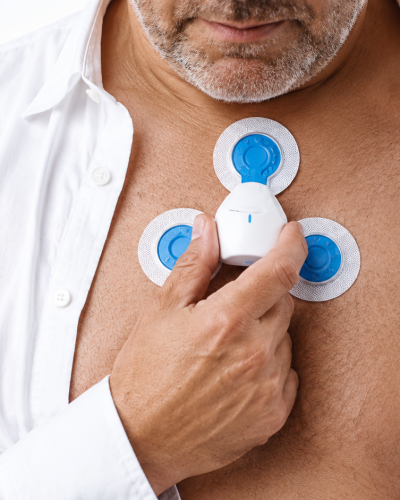
Your GP, specialist, or our team may recommend a 24-hour Holter monitor for any of the following reasons.
Your Appointment
Yes — short showers are fine. Simply pat the monitor dry afterwards and avoid baths, swimming or submerging the device in water. There’s no need to plan your monitoring period around it.
Light to moderate exercise such as walking is absolutely fine and is actually encouraged, as symptoms often occur during activity. We would advise avoiding contact sports or vigorous exercise that might dislodge the electrodes. Swimming is not possible.
This is common and the recording is still valuable. Our cardiology doctor will analyse the full 24-hour trace for any underlying rhythm abnormalities even in the absence of symptoms. If no meaningful abnormality is found and your symptoms are very infrequent, a 7-day or 14-day monitor may then be recommended to increase the likelihood of capturing an event.
The monitor is small and discreet. It attaches directly to the electrodes on your chest — there’s no belt unit or trailing wires — so under normal clothing it’s generally not noticeable. Most patients wear it comfortably throughout a working day.
A 24-hour monitor is most appropriate when symptoms occur most days or are suspected to be related to exercise or daily stress. If your palpitations or dizziness only happen once or twice a week, a 7-day monitor provides a better chance of capturing an event. We also offer 14-day monitoring for very infrequent symptoms.
Your monitoring is provided in partnership with CardioScan, a CQC-registered specialist cardiac monitoring service. Your device is posted to you, and once returned, your recording is analysed by CardioScan’s cardiac physiologists and reported by our cardiology doctor. You receive a clear written report, and the whole process is overseen by our clinical team at Jenhams.
Yes. Your written report is sent to you. Many patients also like to talk their results through in person, so we offer a private GP consultation at Jenhams to go over your report, explain what it means for you, and agree any next steps — whether that’s reassurance, starting treatment, or arranging an onward referral. You can book this when you arrange your test, or once your results are ready (from £60).
Of course. If you haven’t been referred for a specific test, the right length of monitoring depends mainly on how often your symptoms occur. If you’re unsure, we’d recommend a short private GP telephone consultation first: one of our GPs will review your symptoms and history and recommend the most appropriate test, giving you the best chance of a clear answer first time. The consultation fee can be redeemed against the cost of your monitoring (from £20).

45 South Street,
Dorking,
Surrey,
RH4 2JX